Thursday, May 5, 2011

Roll Calls That I Forgot to Post

**Just a note that I was present for the entirety every class; these should be every single roll call**

Class 13, Roll Call 2

Class 13, Roll Call 1

 Class 12, Roll Call 1

 Class 12, Roll Call 2

Class 12, Roll Call 1

#FINAL 8: Course Evaluations

 The initial page, loading correctly

After submitting it, it gave me an error and told me to hit "Back" and try again
This is the screen I get when I hit "Back", but I can't get any other sort of confirmation page.

BC Website is a flaming piece of garbage.

This is me taking the course evaluation for the MT351 class.

This is a part of the Final from the Immersive Education course that I am taking at Boston College. The course is called Discovering Computer Graphics. For details, visit the immersive BC portal at http://ImmersiveEducation.org/@/bc

#FINAL 6: Your View of the "Future of Immersive Education"

The Immersive Education initiative is certainly an interesting one, but it is really hard for me to judge how far or how much potential there is to this form of teaching. I will start off by saying there is huge benefits of teaching in an online or virtual environment. These include convenience, exploration, immersion, and really just overall fun. But, at the same time during an earlier assignment for the Sunday course I mentioned some of the issues with Immersive or online education, particularly in virtual worlds. I will once again quote the Terra Nova article (which can be found here: http://terranova.blogs.com/terra_nova/2007/05/teaching_in_vr_.html

I will try to echo some similar points, without quoting or repeating myself. My other post is available here: http://mt35801-tang.blogspot.com/2011/04/class-11-4.html

Teaching in a virtual environment is extremely restrictive. Rocket World, in my honest opinion is severely outdated and massively broken. It is simple, but that's about all it has going for it. The MP3 we listened to detailed Moore's Law and the tremendous speed the video gaming industry is growing at, while also mentioning John Carmack and id. Looking at it from an optimistic point of view, sure the possibilities and potential of Immersive Education seem endless, but right now it is stuck using freeware and Open Source software. Prof. Walsh also mentioned that virtual worlds tend to lag behind video games, even though they are directly tied to VG development. This, coupled along with the fact that the video game development scene is nothing like what it was before, is the main obstacle to overcome for Immersive Education.

Second Life is dead; people may still be playing it, but in the grand scheme of things it means very, very little. On that same note, OpenSim (Wonderland) is even more unstable and outdated. There needs to be another platform for iED to operate on in the near future. This necessity brings me back to my previous point of how VGs are not what they used to be. The big releases nowadays are not created by a small number of people working on it for a month or two. They take two to four/five years to make, with staffs of over 100 members. Everything is about making money and profit. As such, nothing is free anymore. People do not give away their products, so finding something like Second Life (but a more quality product) is nearly impossible. Unless someone gives out the source code for their product and someone in the iED initiative actively takes their time to mod that product, no virtual environment is going to come close to being sufficient with the technology at the time.

I skimmed the beginning of Patrick's write-up to see what he touched upon. He mentions the privatization of iED as something that will occur in the future. I don't know whether it'll happen or not, or the current landscape of online classes (yes they are available, but are the number of people taking these classes growing exponentially? I am ignorant of such statistics). But at the end of the day, I think this is something that needs to happen. Regardless of where the funding comes from, I think there needs to be more resources and manpower poured into the iED platform to continue making it viable. I'm not encouraging making iED purely for profit, but the limitations of the platform can largely be fixed by utilizing better tech. Making a profit off education is just the added bonus.

As the worlds in video games grow more and more immersive with each iteration, virtual worlds are not improving in the slightest. The rift between the two grows larger and larger, and how "fake" virtual worlds becomes more pronounced. There is a large difference between this two screenshots:

The Elder Scroll V: Skyrim

My avatar in Rocket World

I fear the more pronounced the differences between video games and virtual worlds is, the more irrelevant "Immersive" education will become. That's not to say I think iED will die in 10 years. The virtual worlds/environments part of the initiative needs to be revamped, but I wholeheartedly support online education. Audio Whiteboard (when working) is an amazing tool, which should also be iterated on to add new features. There are a few options to "fix" the virtual world issues. While I did say that games have staffs of over 100+ people, projects like Minecraft still exist.


While it isn't free, an open playground like Minecraft could an interesting tool for education. Question is... where does the licensing fee for using Minecraft come from. Another option would be to invest in augmented or virtual reality tech. Kinect and/or PS Move+Eye is relatively cheap consumer-grade tech, and the possibilities there are endless. Whether all the research being done at universities (hacking, at this point) to implement different uses for the tech trickles down to mass market education, I'm not sure. But if highly specialized fields such as medicine are going to use the tech, I'm sure classrooms could get some benefit out if it too.

Again, I'm not sure what the situation with iED is currently, but resources (money, mostly) and manpower don't magically appear. However, I am still very curious how Immersive Educaiton will all play out in ten years, but beyond these concerns I'm not really sure what to predict. For now, I think it is more than sufficient to use iED for K-12 (maybe like K-6) students. The magic of virtual environments has not escaped their young minds yet :) It does make me glad to hear about the students in South Park Elementary really enjoying and embracing the technology. I am glad to have been able to help in creating objects to be used for education.


For more information about the Immersive Education platform, please visit  the homepage:


http://ImmersiveEducation.org/

#FINAL COMPLETE

Powerbullet Getting Started // Powerbullet Tutorial (Practice)
Final #1 (Flash / Powerbullet .swf files) + Creation
MediaFire Link to .swf assignments #1-4 + Final

Patrick and I were the ones who led that class and described the process needed to create an astronaut/rocket to everyone else. As such, the screenshots for my astronaut are from the Sunday class. I did however build a rocket from scratch.
Final #2 (building basics in Rocket World) + Creation
Final #3 (group building project)
Reminder of Extra Credit for creating my own Monocular Depth Cues instead of finding them
Final #4 (Monocular Depth Cues)
Creating Final #5
Final #5 (http://evolver.com/)
Final #6: Your View of the "Future of Immersive Education"

Final #7: Group 3D Building Project Part 1 - Rumpelstiltskin Loom + Creation
Final #7: Group 3D Building Project Part 2 - Cinderella Chandelier + Creation
Final #8: Course Evalutations

Thursday, April 28, 2011

#FINAL 7: Group 3D Building Project - Part 2 Chandelier

 Creating the first layer

 Creating the second layer

 Copying the second layer and shifting it to make a lower layer. Rotated it 45 degrees so it would be alternating
Just... creation a solution to why the layers aren't "connected", I guess it's a frame

 Finished view from the top, with a third layer added

LINKING: Edit menu open of the final product, everything is linked so it can be copy-pasted as needed (was linking each layer as I went along anyways)

 ADDING GLOW: After hearing feedback from the K-12 Group, they wanted me to make the chandeliers glow so I added a glow effect on the candles. The environment wasn't loading at all at the time, but you can see the glow on the candles at least.

INVENTORY: A screenshot showing that a copy of the chandelier was taken into the inventory of Immersive23. The process is basically right-clicked the object (once it's all linked) and choosing "Take". It'll end up in the "objects" folder in the inventory, after which you can rename the object. To create a copy from the inventory, simply hold-and-drag the object from the inventory into the environment.

This is another example of creating objects in a Virtual World (Fairy World). We were tasked with creating objects for a K-12 initiative, involving fairy tales.This object is a chandelier with glowing candles, from the Cinderella fairy tale. The parts were created individually and then linked together. Finally, a copy was taken into the inventory so it can be used at a later date.

This is part two of a Final exercise from the Immersive Education course that I am taking at Boston College. The course is called Discovering Computer Graphics. For details, visit the immersive BC portal at http://ImmersiveEducation.org/@/bc

Thursday, April 14, 2011

#FINAL 7: Group 3D Building Project - Part 1 Loom


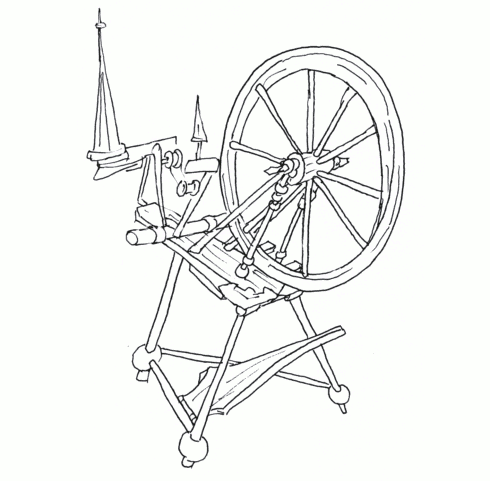
We were tasked to build a loom for a potential Rumpelstiltskin fairy tale.
We used this for the target image.

 I created everything on the table, essentially. Wheel, spoke, and some of the stands.

 A tripod thing, I don't know

 Spindles? For threading the cloth through

 Finished view #1

 Finished view #2

Finished view #3

Note: We couldn't go back and link/save the loom because Fairy World exploded and had to revert to a previous state. I don't really know what happened to the loom...

This is another example of creating objects collaboratively in a Virtual World (Fairy World). We were tasked with creating objects for a K-12 initiative, involving fairy tales.This object is the loom from Rumpelstiltskin.

This is part one of a Final exercise from the Immersive Education course that I am taking at Boston College. The course is called Discovering Computer Graphics. For details, visit the immersive BC portal at http://ImmersiveEducation.org/@/bc

Creating Final 5

Evolver Avatar Creation

 Creating an account...

 Uploading a photo

 Putting red dots on eyes, sideburns

 More dots, on the nose/mouth
 Jawbone, chin

Clone creation

 Clone submitted

 End result... not editing it, looks terrible though

Saving the new avatar with the cloned face

After choosing an animation (FIFA soccer kick), creating the post to export to Blogger

This is the process of creating a custom avatar using a personal photo of my face. Visit http://www.evolver.com for more details and to create your own!

It is a final exercise from the Immersive Education course that I am taking at Boston College. The course is called Discovering Computer Graphics. For details, visit the immersive BC portal athttp://ImmersiveEducation.org/@/bc

#FINAL 5: http://evolver.com/


Evolver Avatars

avatar
Click here to view my Avatar!


This is an example of a custom avatar using a personal photo of my face. Visit http://www.evolver.com for more details and to create your own!

It is a final exercise from the Immersive Education course that I am taking at Boston College. The course is called Discovering Computer Graphics. For details, visit the immersive BC portal athttp://ImmersiveEducation.org/@/bc

Thursday, April 7, 2011

Class 11: Fairy Stuffz

We entered the Fairie Tale module in Imprudence to look at the surroundings to see what we can create in the module in the near future for the Immersive Education Initiative's K-12 Technology Working Group. Find out more information here: http://mediagrid.org/news/2011-02_K12.html

 A bridge in the castle

 A bedroom in a tower

Random archer dude

Pirate Ship 

Stonehenge 

 A hut with smoking coming out of it

 Spier-web ridden... gazebo?

 A garrison on an island

Huge shrooms

#FINAL 4: Monocular Depth Cues

***********************************************
**EXTRA CREDIT FOR CREATING MY OWN CUES**
***********************************************

Reading the article on monocular depth cues [3]

 Cue 1: Size
Essentially, objects that are farther away appear smaller.
In this case, object two appears smaller than object one even though their dimensions are the size. [4]

 Cue 2: Occlusion
If an object blocks another object, the former would be in front of the latter.
In this case, object one is in front of object two. [4]

Cue 3: Lighting
Surfaces closer to the source of light are brighter, while the ones farthest get the least amount of light and are therefore the darkest.
In this case, surface one is the closest to the source of light (the sun), surface two is the second closest, while the third surface is the farthest. Of course, the bottom of the cube is actually the darkest, but we can't see it.
We can safely assume that the sun is probably directly above the cube in this example. [4]

Cue 4: Texture Density
Objects with a repeating texture that are farther away look "denser"
In this case, both cubes with brick textures are the same size, but the farther one appears to have bricks which are smaller and much more closely packed together. [4]

 Cue 5: Linear Perspective
Parallel lines appear to converge the farther they are from us, until they meet at the vanishing point.
In this case, the side of the building appears to converge on the blue arrow. As the slanted lines show, the "sides" do look slanted and converging. [4]

 Cue 6: Atmospheric Perspective
Objects that are closer to us are sharp and detailed.
This example is basically the concept of an eye exam chart. The closer you are to the chart, the easier the text is to read. [4]

 Cue 6 (2): Atmospheric Perspective
Objects that are far away are fuzzy, less detailed.
The farther you are from an object, the harder it will be to make it out. This concept builds upon the texture density and size cues, but the example of text shows this cue extremely well. You are no longer able to read the words at this distance. [4]

These are examples of monocular depth cues in Rocket World. We covered six different cues and what they are/how they affect how we see 2D objects. For more on the cues themselves, please refer to http://web3deducation.com/bc/MT35101/ONLINE_CLASSES/3D/CoreWeb3D_ch03.pdf

This is a Final exercise from the Immersive Education course that I am taking at Boston College. The course is called Discovering Computer Graphics. For details, visit the immersive BC portal at http://ImmersiveEducation.org/@/bc